A lease is signed once and then lives for a year. Life doesn't wait that long. Three months in, the tenant adopts a dog. Six months in, a partner moves in. In month nine you agree to split the cost of a new dishwasher the tenant's kid broke.
Every one of those changes the deal. And the most common way landlords record it is a text message — "sure, the dog's fine, add $35 a month" — which is exactly the record you'll wish you hadn't relied on when the tenant moves out and disputes the pet rent.
This guide covers which document each kind of change needs, what makes it enforceable, the changes landlords most often get wrong, and how to keep all of it tied to the lease it belongs to.
Addendum, amendment, or a new lease
These three get used interchangeably. They aren't the same thing.
| Document | What it does | Typical uses |
|---|---|---|
| Addendum | Adds terms the lease didn't cover | Pet, parking space, storage unit, an occupant, a one-time agreed charge |
| Amendment | Changes terms the lease already has | Rent amount, end date, who pays a utility |
| New lease | Replaces the agreement | A change of the people on the lease, or a restructure big enough that patching it would be unreadable |
In practice many landlords call everything an "addendum," and courts generally care more about what the document says and who signed it than about its title. But the distinction is worth keeping in your head, because it tells you what to check: an addendum shouldn't contradict the lease; an amendment deliberately does, so it needs to say precisely which clause it replaces.
If you find yourself writing a third addendum to the same lease, or an amendment that rewrites the rent and the term and the parties, that's the signal to sign a new lease instead. A tenant — or a judge — should be able to understand the deal without reading five documents in order.
What makes a mid-term change hold up
Specific state rules vary, but a change that survives a dispute almost always has these five things:
- Both parties sign it. Every tenant on the original lease, not just the one who asked. A change signed by one of two co-tenants is an argument waiting to happen.
- It points at the original lease — by property address, unit, the lease's start date, and the parties' names. "This addendum modifies the lease dated March 1, 2026 for 413 Beasley, Main unit, between…"
- It says when it takes effect. A date, not "going forward."
- It states the new term precisely. Not "tenant may have a pet" but which pet, what size, what it costs, and who pays for damage.
- It says everything else stays the same. One sentence — "all other terms of the lease remain in full force" — prevents the argument that the new document replaced the old one.
A text message thread can satisfy some of this, and some courts do accept electronic agreements. But you're betting on a judge reconstructing intent from a chat log. A one-page signed document removes the bet.
The changes landlords get wrong
Adding an occupant vs. adding a tenant
This is the most consequential one. When a partner or roommate moves in, you have two very different choices:
- Add them as a tenant (co-tenant). They sign, they're jointly responsible for the full rent and any damage, and they have the same rights to the unit as the original tenant. This is really a change of the parties, so many landlords sign a new lease rather than an addendum.
- Add them as an occupant. They're allowed to live there, but they aren't a party to the lease and aren't personally on the hook for the rent. The original tenant stays responsible.
Neither is wrong. What's wrong is not deciding — letting someone move in and discovering at move-out that you can only pursue the person who signed. Screen an incoming co-tenant the same way you screened the original applicant.
Pets
A pet addendum is where the paper and the money most often drift apart. Decide up front whether you're charging a refundable pet deposit, a non-refundable pet fee, or monthly pet rent — they book differently, they're taxed differently, and in most states a pet deposit counts toward the cap on total deposits. We cover the accounting in Pet Deposit vs. Pet Fee vs. Pet Rent.
And remember that an assistance animal isn't a pet. You generally can't charge pet fees or pet rent for one, and a "pet addendum" isn't the right document for it.
Raising the rent mid-term
Usually you can't. A fixed-term lease locks the rent for the term unless the lease itself provides for an increase (a scheduled step-up, or an index clause). An amendment raising the rent mid-lease only works if the tenant agrees to it and signs — and they have little reason to. The right moment for a rent change is the renewal, with the notice your state requires; see How Much Notice to Raise Rent.
One-time agreed charges
"You broke the dishwasher, we'll split the $640" is a perfectly good agreement — if it's written down with the amount, the due date, and both signatures. Without that, it looks like a deduction you invented at move-out.
The paper is not the money
Here's the part most landlords miss, and most software doesn't help with: signing an addendum doesn't change what you bill.
If the pet addendum says $35 a month in pet rent, that $35 only shows up on the tenant's ledger if someone adds it as a recurring charge. If the dishwasher agreement says $320 due on the 15th, it only gets collected if someone bills it. The document is the agreement; the charge is a separate action. Skip the second step and you'll discover, twelve months later, a signed addendum for pet rent you never collected — and a tenant with a reasonable argument that you waived it.
So for every change, make two lists: what the document says, and what has to change on the ledger (a new recurring charge, a one-time charge, a deposit to hold). Then check them against each other.
Renewals: the clean moment for changes
Most mid-term changes are easier at renewal, when you're already writing new terms. A few habits:
- Start 60–90 days before the lease ends. That leaves room for your state's notice period and for the tenant to decide.
- Roll the year's addendums into the new lease. The pet, the occupant, the parking space — write them into the renewal itself so the new lease stands on its own.
- Decide how rent moves. A flat percentage is simple. A clause tied to inflation (CPI) is harder to argue with and removes the annual negotiation — as long as the lease spells out which index, which month, and any cap.
Keeping the paper trail
A mid-term change is only useful if you can find it. Wherever you keep leases, keep the addendums attached to the lease they modify, with the date each was signed and whether every party signed. A folder called "misc signed stuff" is how an addendum goes missing the one time it matters.
How Corbica handles it
We built lease addendums around the problems above — especially the gap between the document and the money.
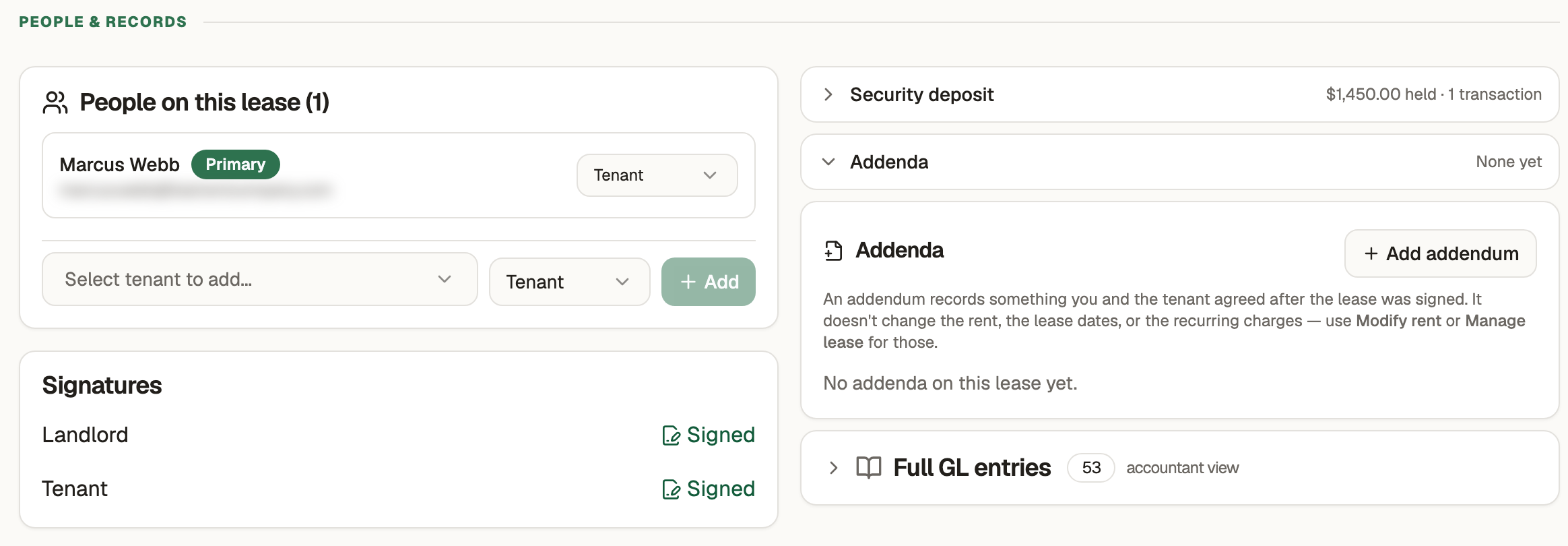
Every addendum lives on its lease. Open a lease and the Addenda card sits under People & Records, next to the security deposit and the signatures. Each addendum shows its status there — draft, sent, signed, declined, or cancelled — with the executed PDF and the signing certificate once it's signed.
Four ways to write one. Add addendum opens a single dialog with four tabs: Write it in an editor, Describe it and let Corbica AI draft it, pick clauses From your library, or Upload a file you've already had signed. Merge fields like {{tenant_name}} and {{property_address}} fill in from the lease when the document is produced, so every addendum names the right agreement — and a variable that doesn't match a real field is refused when you save, so a literal {{like_this}} can never reach a document someone signs.
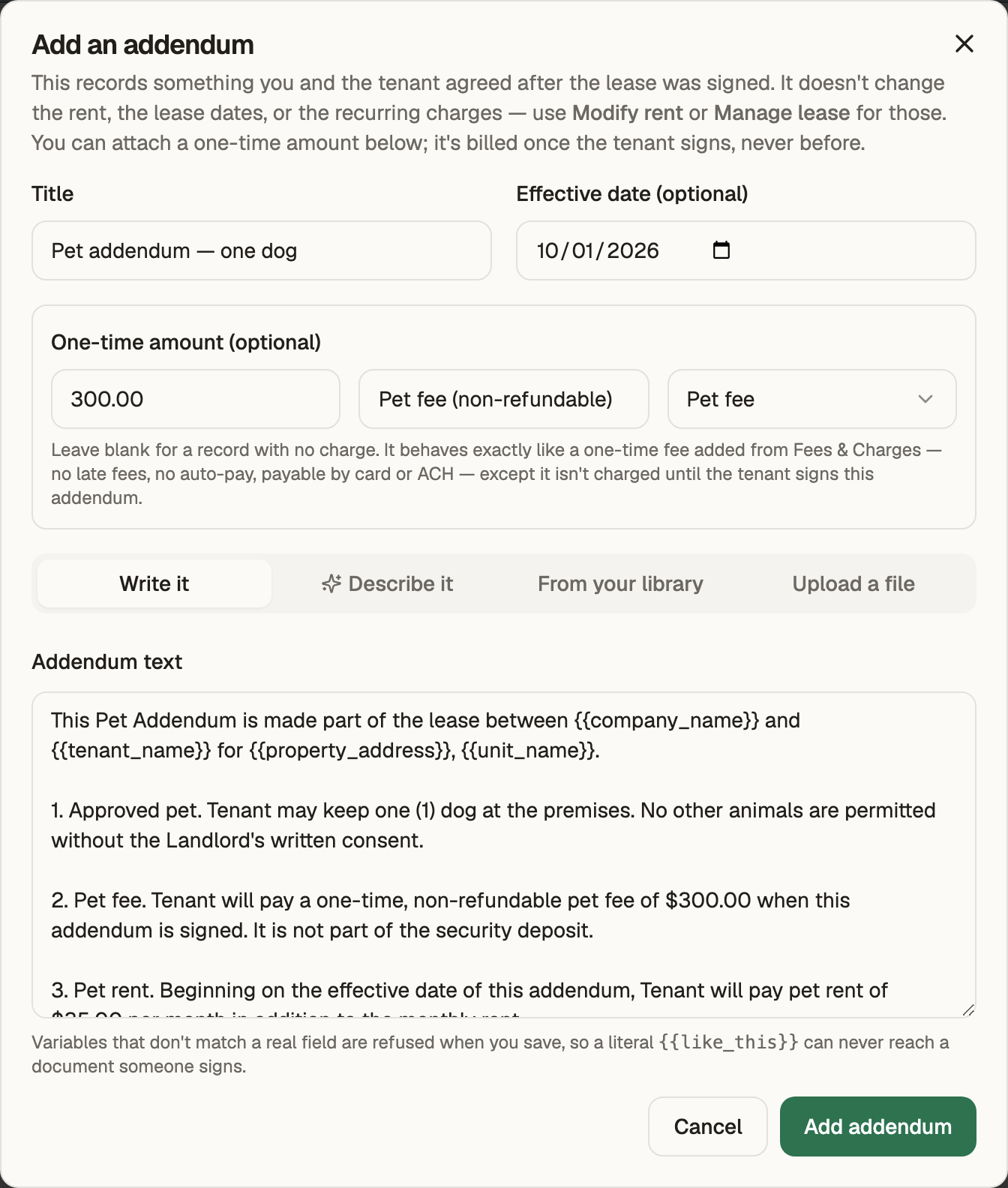
An agreed one-time amount bills itself — once it's signed. The split dishwasher, a non-refundable pet fee: enter the amount on the addendum and pick what kind of charge it is. It's billed to the tenant when they sign the addendum, never before, so a charge nobody agreed to can't reach their ledger.
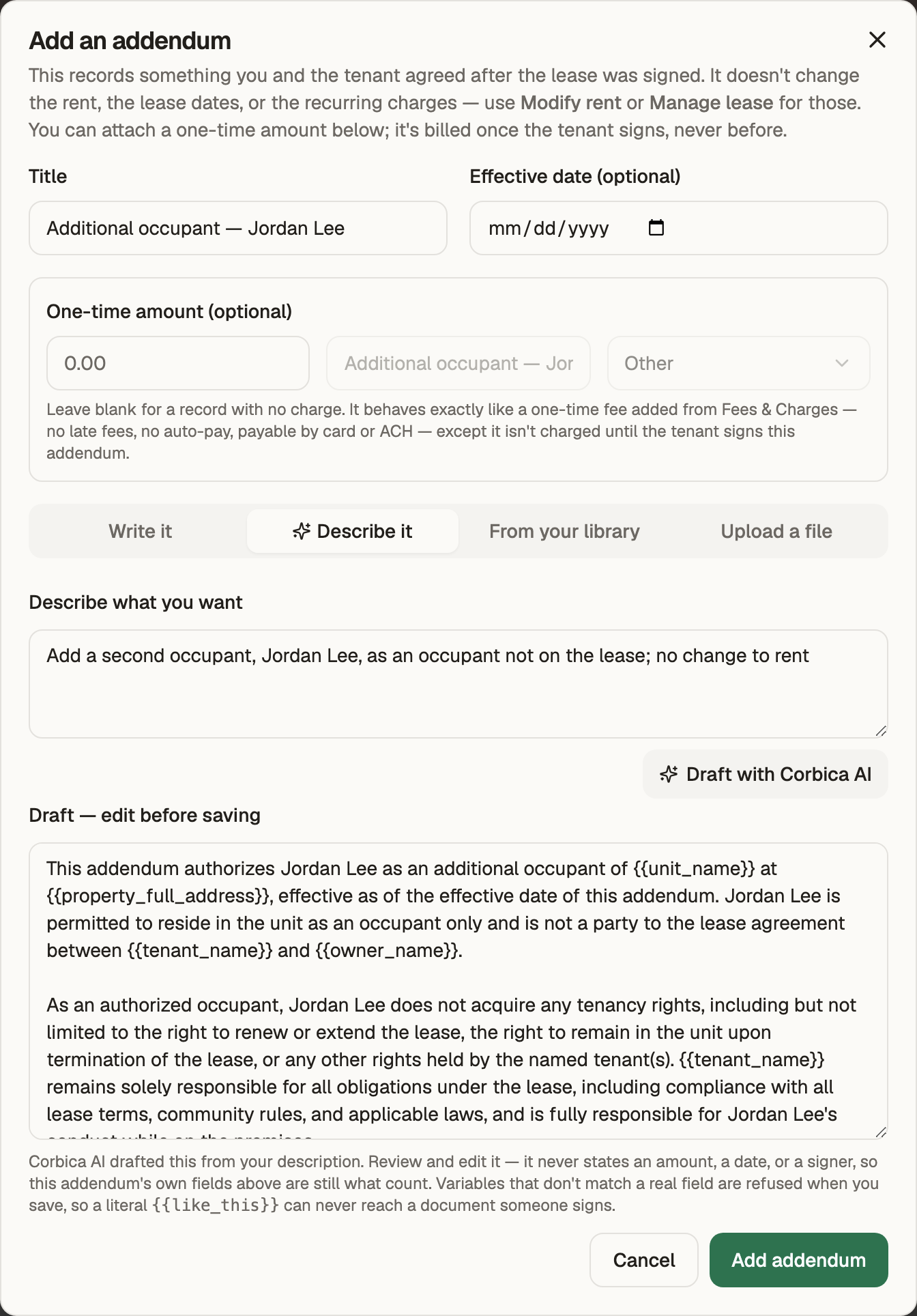
Describe it, and Corbica AI drafts it. Type "add a second occupant, Jordan Lee, not on the lease; no change to rent" and get a draft back to edit. The draft never states an amount, a date, or a signer — those come from the addendum's own fields — and nothing is saved until you save it.
Signed, and visible to the tenant — when it's sent. Send the addendum for e-signature from the lease. It appears on the tenant's My Lease page once it's sent, not while you're still drafting.
Recurring changes stay a deliberate step. An addendum never quietly edits the rent or the recurring charges, and the dialog says so in its first line. The $35 a month in pet rent is a recurring fee you add on purpose — the "two lists" from earlier, built into the screen.
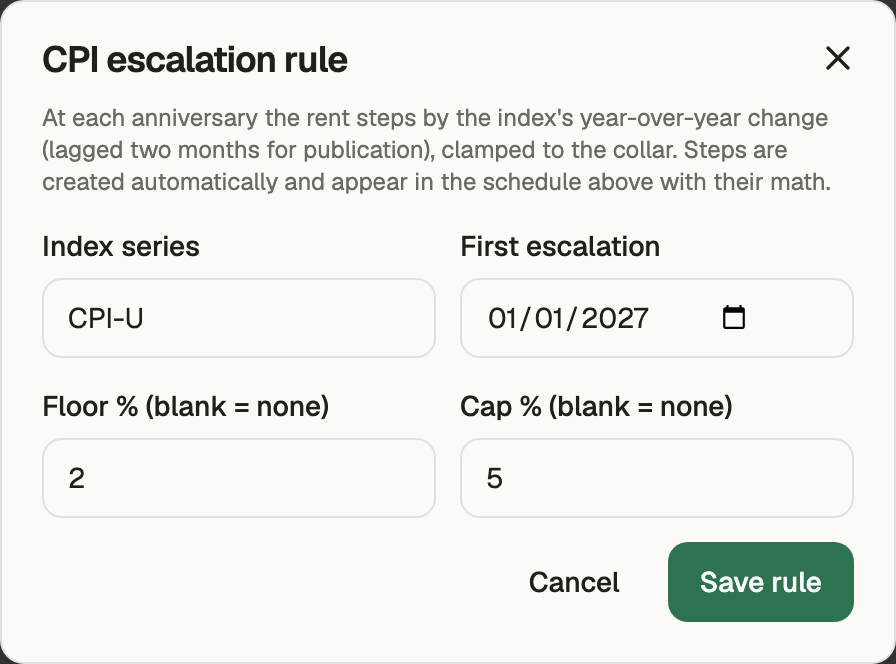
Rent that moves with inflation. For leases with an index clause, set a CPI escalation rule on the lease — the index, the first escalation date, and an optional floor and cap. Each year's step is created automatically and shows in the rent schedule with its math. And when a lease approaches its end date, it surfaces for a renewal offer.
The short version
- Addendum adds terms, amendment changes them, new lease when the parties or the whole deal change.
- Every change: all parties sign, it names the original lease, it has an effective date, it's precise, and it says the rest stands.
- Decide occupant vs. co-tenant before anyone moves in.
- You usually can't raise rent mid-term — do it at renewal, with proper notice.
- The document isn't the money: every change that affects what the tenant pays needs a matching ledger change.
- Keep every addendum attached to its lease, with its signature status.
This guide is general information, not legal advice. Landlord-tenant law varies by state and city; check your local rules or talk to a local attorney before relying on a specific form.